
[Finance] Power of Compounding

Audio version: An AI-generated two-person discussion exploring the ideas in this post.
Albert Einstein was once asked about the most powerful force in the universe. He didn’t point to the stars. He gave a surprising answer: compounding. He should know. His own career was a great example of its power. His genius was not a single flash of brilliance. It came from relentless curiosity and incremental learning, with each discovery building on the last.
This is the secret of compounding. It’s a force that governs more than just money, but it is in our finances that we can see its power most clearly.
To understand compounding, first consider its opposite: simple interest. Imagine you put $1,000 into a bank Certificate of Deposit (CD) that pays 5% interest per year. With simple interest, you would earn the same $50 every year. After five years, you’d have your original $1,000 plus five years of interest, for a total of $1,250. It’s clean and easy to follow.
But compounding is where the magic happens.
Let’s take that same $1,000 at 5%. After the first year, you earn your $50 in interest. With compounding, that interest doesn't just sit on the side; it gets added back to your original pile. For the second year, you aren’t earning interest on $1,000, but on $1,050. So instead of another $50, you earn $52.50.
You might not be impressed by that extra $2.50. The difference is tiny at first. But this is where the most important ingredient comes in: time.
Give that small process time to work. After 10 years, that compounding $1,000 will be worth about $1,629, nearly $130 more than with simple interest. After 20 years, it grows to over $2,650, beating simple interest by more than $650. And after 40 years? Your original $1,000 becomes more than $7,000. The simple interest path would have left you with just $3,000. By letting your money build on itself, you ended up with more than twice as much. Your money started making its own money.
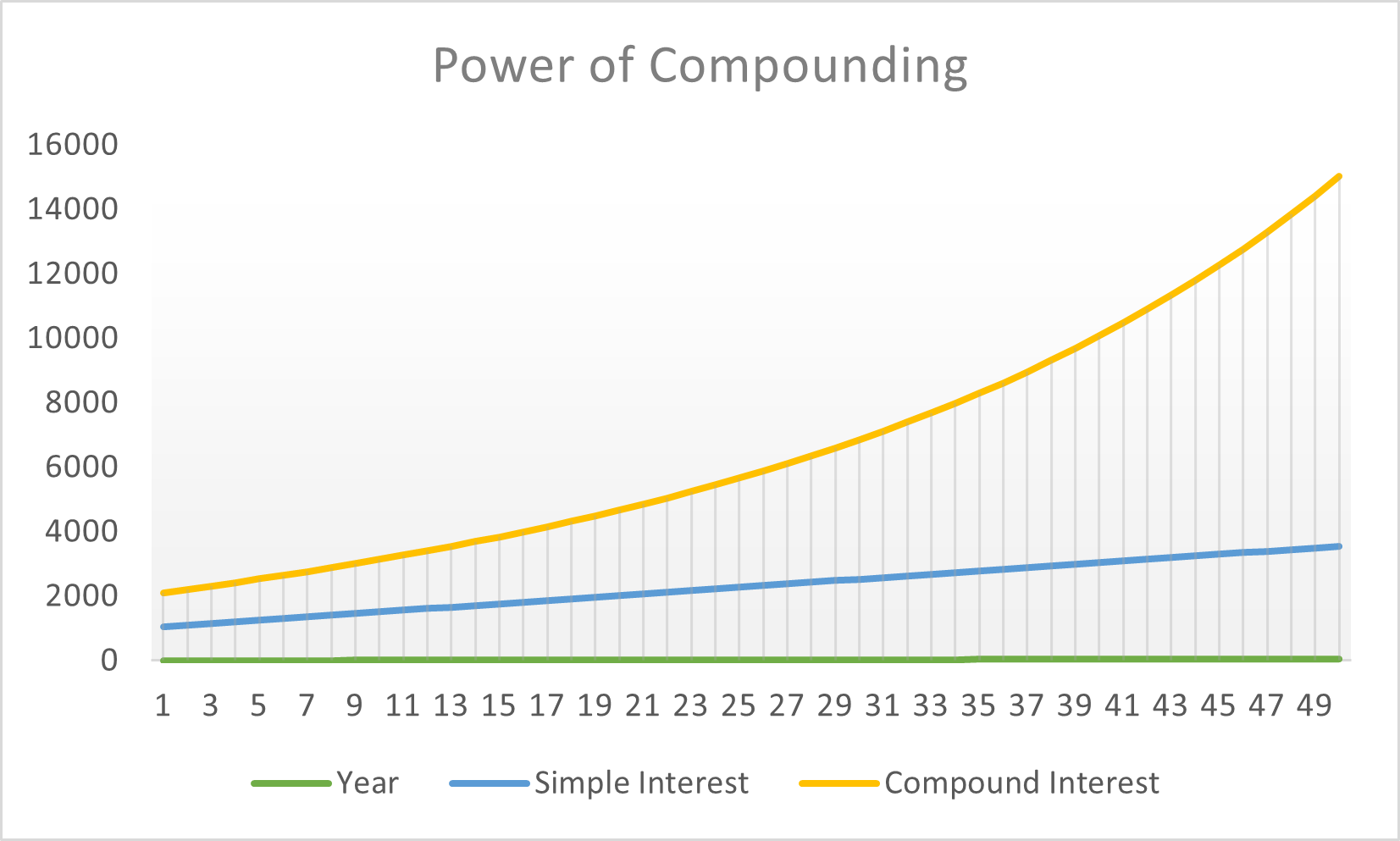
This is the power that famed investor Warren Buffett harnessed. He started investing as a boy, but nearly all of his immense wealth was generated after his 50th birthday. His fortune is a monument to patience, built by giving the compounding machine decades to run.
Think of it as a machine. To keep it running smoothly, you must protect it from friction. The two biggest sources of friction are costs and taxes. High investment fees and taxes on your gains are like grit in the gears, slowing the machine and robbing you of your future growth. Keep your costs low, and the machine will run faster and longer.
But be warned: this powerful tool is a double-edged sword. Just as your savings can snowball for you, your debts can snowball against you. A credit card balance left unpaid will also compound, with the interest you owe starting to rack up its own interest. The snowball starts rolling downhill, but this time it’s threatening to run you over. Use debt carefully, for important goals like buying a home. Attack other debts with vigor before they have a chance to grow.
Harnessing this force doesn’t require genius. It requires discipline. Start as early as you can, even with small amounts. Time is the most critical fuel for your compounding machine. Invest regularly to build the habit. And always make sure your earnings—your interest and dividends—are put right back to work for you.
This simple but profound idea is your greatest financial friend. It reminds us that in finance, as in life, the most dramatic results often come not from a single, heroic effort, but from small, consistent steps taken over a very long time.
Series: Personal Finance