The Three Cs
Complicated, Complex, and Confusion

Audio version: An AI-generated two-person discussion exploring the ideas in this post.
At A Simple Project, our goal is to simplify the world. To do that, we must first understand what makes it difficult. We often use the words complicated, complex, and confusing as if they were the same, but they are not. Each points to a different kind of problem, and each demands a different approach. Knowing the difference is the first step toward finding clarity.
Complicated
What do we mean when we call something "complicated"?
Think of a difficult recipe, like a soufflé, with its many precise steps. Or a dense musical sonata that ties your fingers in knots. Think of setting up new software or planning a vacation across three different countries.
These tasks can feel daunting. They have many parts and many steps, but they are not mysteries. They are puzzles. With patience, practice, and a good plan, you can solve them.
Complicated things have numerous pieces, but those pieces can be counted and their connections predicted. Though they may seem overwhelming at first, they yield to a systematic approach. Most complicated things, after all, were designed by people—a car, a clock, a computer program. That means someone, somewhere, knows how they work and can explain them.
So how do you handle a complicated system? You take it apart. By studying its parts, you can understand the whole. The path through the complicated is knowable; you just need to find the guide and begin.
Complex
Do not confuse what is merely complicated with what is truly complex. True complexity lives in systems that are alive with change: a national economy, a living ecosystem, the human body. You cannot understand these systems by taking them apart, because their essence lies in the unpredictable dance of their many independent parts.
Think of the global economy in early 2020. A virus in one city triggered lockdowns, idling the world's factories. Cargo ships had nowhere to go, and store shelves went bare. The shock rippled through financial markets, where fear itself caused the downturn it predicted. The response was a storm of interacting forces: governments injected trillions of dollars, companies pivoted to making new products, and workers vanished from offices. Each part influenced the others in ways no one could fully predict.
This is the nature of complex systems. They are made of countless independent agents whose interactions, not individual choices, drive the system's behavior. These systems are non-linear; a small nudge can create a tidal wave of change. They adapt and learn.
To work with complexity is not to fix it like a machine, but to navigate it like a current. We must learn to observe its patterns, probe it with small experiments, and adapt as it responds. We must, in short, learn to dance with it.
Confusion
Finally, there is confusion—a problem of a different nature entirely. It begins not in a system, but in the mind.
Ming, a new homeowner, had a simple task: turn on the water for his sprinkler system. The note from the previous owner was clear: "Turn on the faucet next to the garage." But when Ming went outside, there was no faucet. Confused, he began to doubt himself. After sending a frustrated photo of the spot—a wall with a small hole—the mystery was solved. His remodelers had plastered over the faucet.
This is the essence of confusion: the gap between what we believe to be true and what is actually there. It is the feeling of being lost because your mental map no longer matches the terrain in front of you. It is a signal that a critical piece of information is missing.
How do you fight confusion? You close the gap. You must stop doubting yourself and start investigating your reality. Become a detective and look for the missing fact that will make the world make sense again.
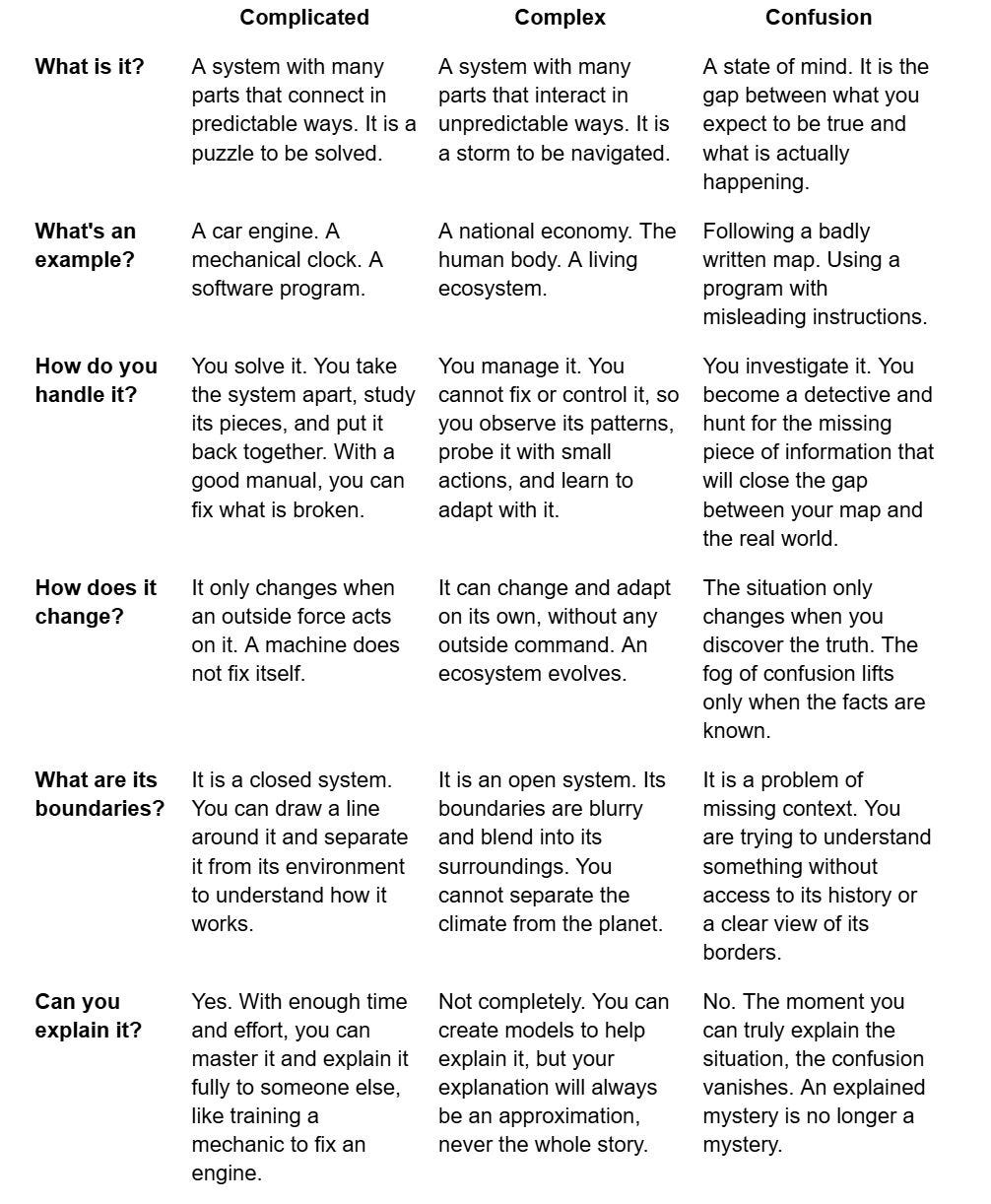
A Comparison of the Three Cs
These three words describe different kinds of problems. The table below summarizes the distinction.